Friday, March 23, 2018

Unspun: Heart of a Thief

I really love fairy tale adaptations. I tend to agree with Debora Geary who said, "Fairy tales have more logic holes than the average conversation with a three year old." These stories are full of improbable incongruities that have nothing to do with pumpkin coaches or fairy godmothers. And so there is something inescapably fun about unpacking motivations that could drive our beloved characters into their bizarre situations. There is something incredibly satisfying about rearranging background events and people to account for the supremely unlikely Ever After that the story demands. And, at heart, there is something simply wonderful about telling a familiar story in a new and exciting way.

The short story anthology Unspun comes out April 10, and includes my story Heart of a Thief, in which I get to do exactly this sort of unpacking and rearranging to Jack and the Beanstalk.

You remember the story: Jack goes to sell the family cow and ends up trading her for magic beans. This seems like an awful bargain, but those beans turn out to be the real deal. Jack bravely acquires gold coins, a magic harp, and a goose that lays golden eggs. Oh, and the giant who owned them dies when Jack chops down the beanstalk. For the shocking low price of one cow (and possibly being charged with manslaughter, depending on the legal status of giants in this setting), Jack gets fame and fortune.

You can see the obvious problem. Why on earth would someone who has magic beans trade them for an old cow? That person ought to use the beans to go get the treasure themselves. What could possibly motivate the kind old man to part with his miraculous legumes?

Well, there are a lot of possiblities. Here are a few that I entertained:
  • The man is Jack's estranged father in disguise, coming back to make amends by giving Jack something valuable.
  • It's the giant's wife in disguise, hoping to get rid of her good-for-nothing husband. That explains why she keeps hiding Jack in the house on repeated visits despite Jack's habit of running off with their stuff.
  • Buying the cow is step one of a heist. It's easier to rob a farmhouse than a giant's stronghold, and he's planning to steal the treasure from Jack.
  • He stole the beans from a passing wizard, not knowing how valuable they are. Now he's being pursued and needs to offload them quick.
  • The cow is magic! Forget golden eggs, this cow's milk is like the fountain of youth!
  • No wait, the cow is his true love, a princess enchanted years ago by an evil witch. (This might be the most plausible yet. Princesses, witches, and true love are hardly in short supply in these stories.)
In the end I settled on something else, and had a great time writing my way through the old man's story. Designing the world and magic was fun, and telling the story was satisfying, but figuring out the man's motivation for buying Jack's cow was my favorite part.

~~~~~~~~~~

For more information about Unspun, see my post announcing the anthology.
For my take on another fairy tale, check out my analysis of Goldilocks and the Three Bears.

Are you looking for more fairy tale retellings? My two favorite adaptations are Gail Carson Levine's Ella Enchanted and Shannon Hale's Book of a Thousand DaysI am also currently enjoying the webcomic Namesake. More authors of great retellings include Robin McKinley, Patricia WredeJuliet Marillier, and Jessica Day George.

Thursday, March 22, 2018

Unspun: Announcing a book release!

I'm thrilled to announce that a short story of mine called "Heart of a Thief" will be published in an anthology set to release on April 10. I will post a link as soon as the book is available.

Here is the cover and the publisher's description:


Whatever happened to “happily ever after”? 
Heroes search for happiness, villains plot revenge, and nothing is as easy as it once seemed. Gretel suffers from post-traumatic stress disorder, an orphan girl questions Rumpelstiltskin’s legacy, a monster cat searches for a child to eat, and the pied piper realizes stealing a hundred and thirty children may not have been his smartest idea. 
Fairy tales have endured for centuries even though—or perhaps because—their conclusions are often more unsettling than satisfying. In Unspun, eleven storytellers come together to challenge and explore a few of those classic tales. Unexpected twists are sure to provoke both thought and laughter.  
Gorgeous illustrations by Ruth Nickle accompany each piece.


I am very fond of fairy tale adaptations, so when I was invited to submit one of my own, I jumped at the chance. The theme of Unspun can be summed up as "After the Ever After," and all of the stories explore what takes place beyond the traditional ending of a given tale. My own story, which I'll talk about in a separate post, takes place after the events of Jack and the Beanstalk. I am pleased with how it turned out, and even more pleased with stories it sits beside in the collection.
Having read the other pieces (two novellas, seven short stories, and two shorter works), I can recommend the collection wholeheartedly. Each piece takes a different approach to accounting for the fallout of a familiar (or less-familiar) tale, and I'm sure you will find several that resonate with you. I have three personal favorites that I will be suggesting to everyone I know:
  • Tatterhood and the Prince's Hand, by Katherine Cowley Based on Tatterhood, this novella is the centerpiece of Unspun, and is a truly standout exploration of acceptance and personal strength. Cowley's excellent storytelling showcases her wonderful characters and interesting magic.
  • Breadcrumbs by Jeanna Mason Stay Based on Hansel and Gretel, this beautifully written story is an intimate look at someone struggling to deal with past trauma. Stay's prose is superb and her characterization of Gretel is supremely empathetic.
  • Ethical Will by Kaki Olsen Based on The Nutcracker, Olsen's story is emotionally authentic and begs for a sequel of its own. I love how the events of the plot intersect with the main character's stages of grief as she mourns her mother's recent death.
You can learn more about the collection at these links. I'll update the list as more become available:
Jeanna Stay's Cover Reveal blog post
Kaki Olsen's Blog Post
Anika Arrington's blog
Editors (Ruth and Kathy) Interview at ThroughTheTollbooth

Wednesday, August 30, 2017

More Science: The Universe Is Not Enough


Disclaimer: I recognize that there are important societal issues to consider when discussing overpopulation. This is a math/science post, so I'm planning to completely ignore those.

"Humans are overcrowding the planet!" is a concern that crops up at least once a generation. Up until now, I have had little patience with the doomsayers. The idea that a family's children after the first (or second or third) are a burden that the world cannot accept is disturbing and offensive to me. Yes, there are problems that come with larger populations, but I generally choose to trust in our ability to solve those problems.

For example, people have been predicting that we will run out of food at least since the industrial revolution. But the the Haber process (invented ~1910) let us create fertilizer, and was just one in a string of many important innovations that have allowed us to support more and more people. Over and over we have surpassed the supposed "upper limit" of sustainable number of humans, and in the process discovered amazing new things. Science!.

Moreover, I trust in the nature of large systems to be self correcting (i.e. parents can figure out whether they can support another child without me or an economist telling them, and those local decisions will be based on global resource allocation).

BUT! This video from Numberphile has convinced me that there is an inescapable upper bound, and that it is approaching far faster than I would have guessed. They calcualted the number of particles in the human body (~10^29), and in the observable universe (~10^80). So if there is nothing in the universe but people, we could make 10^51 of us. I think it goes without saying that that is a LOT of people.

So, no problem, right? This abstract idea is absurdly impossible, yes? NO! If you assume that the world population (now ~7 billion) continues to grow at it's current rate (a little over 1% per year), we have less than 9000 years before we run out of universe! And even though the video doesn't say this, that 9000 year cut-off applies even if we use not just the normal matter, but also the other 95% of the universe made up of dark matter and dark energy. Clearly, something will have to give before that point, and I'm not willing to bet that thing will be the universe.

Presumably there are some other obstacles in the way before we reach that point, but I think we can agree that we have established an absolute maximum, beyond which even the most optimistic would not try to push us.

_______

And, in unrelated science coolness:

Wikipedia just taught me that the first discussion of gravitational waves (detected last year by LIGO - yay!) was by a scientist named Oliver Heaviside. Another instance of perfect naming. Good article on LIGO here.


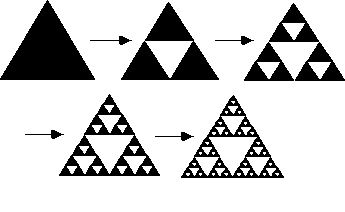
Sierpinski's triangle (below) arises from various apparently unrelated things beyond the obvious stepwise removal of smaller triangles. You can find it from chaotic attraction, from the parity of Pascal's triangle, or from turning a line into a trapezoid iteratively. I only knew about the last one, and was surprised to learn that it shows up in other places this way.

Sierpinski's Triangle

Wednesday, June 28, 2017

Friday, June 9, 2017

Photosynthesis is Amazing!

One of my favorite scientific realizations is the idea that all of the trees and plants we see are basically solidified air. Photosynthesis is the process of using energy from light to turn air (carbon dioxide) and water into sugar, and that sugar is then used both as fuel and as a structural building block to make more plant.

I've wondered how much photosynthesis actually happens on earth, and recently looked up the answer. Current best estimate: 150-175 petagrams per year, or about 0.45 petagrams per day. A petagram is the same thing as a gigaton, but how much is that really?

The most useful comparison I found is that the mass of all living humans is 0.5 petagrams. So every day, plants and algae make enough sugar to rival the combined weight of humanity! Another way to look at it is that a cup of sugar weighs 200 grams. So 0.45 petagrams of sugar is enough to fill up Sydney harbor, or make a sugar cube half a mile on each edge.

Such comparisons aren't entirely fair, because all that sugar isn't just piling up into cubes. Plants use up about half of it as energy. And while the other half gets incorporated into new plant growth, plants are being eaten and converted back into energy just as fast. So really what we are measuring is the daily calorie intake of the planet, which is estimated at ~1% of the sunlight that reaches earth's surface. Hooray for photosynthesis!


Friday, April 28, 2017

Space!

Kelley and I were talking about space last night, partly because the Cassini probe completed a dive between Saturn and its rings, and partly because Jace has been been learning about planets. We watched this excellent video, which starts out comparing the sizes of various planets and stars, then zooms out to compare the scale of galaxies and more.


Such mind-boggling vastness can make one feel very small, so naturally we tried to counter that by thinking of the tiniest things in the universe. Here is the chart we came up with. Unfortunately, I got some things wrong, so please refer instead to the revised chart below it.

Here we have the revision with text labels and more accurate spacing. The axis is a log scale, so each step of 3 brings you to something a thousand times bigger or smaller.


A few of our observations:

  • It takes approximately the same step in size (~9 orders of magnitude=a billion* times bigger in diameter) to get from an electron to an atom, from an atom to us, and from us to the sun.
  • Two more of those steps take you from sun to observable universe, but the galaxy is well past the first of those. (This was the main error in my napkin version--the galaxy is approximately one billion solar systems across, not one billion suns.) Note: That is linear distance; our galaxy contains 100 billion stars. 
  • Two big steps in the other direction take you from an electron down to the Planck length (below which "distance" ceases to mean anything).
  • Once you contemplate the vastness of something a billion-billion-billion** times bigger than you, it is not helpful to say "Well, yes, but that's just the observable universe. The whole thing could not only be far vaster, it could truly be infinite."
For a great illustration of the bigger-than-us half of the chart, check out this xkcd image. If you want to look at an interactive zoomable chart with a lot more objects than mine, this is a good one.


*I use the American billion here. If you are feeling European today, feel free to translate to milliard.
**Octillion for Americans, or quadrilliard for the traditionalists.

Monday, April 24, 2017

Useful Tools: Books and Movies


This is the second in a series of posts recommending useful resources in various areas. These are apps or tools I use regularly. Today's topic is: Books and Entertainment.
All apps are for Android, and links will take you to the Google Play store.

https://blogger.googleusercontent.com/img/b/R29vZ2xl/AVvXsEj-ukoOYWDUhRrDghCuyMolEtvJnRc8wxEBGMSq8mepabenh6hIzjRwD4t6xQXE1lWCK6e4x_Rxjg8kZtLUaPQoEMaX7S5tK5kLZhzgslw-3p6Pnd-ofssiKGw1EDfhz9fGtzI-apF12I0/s1600/overdriveLogo.JPGOverdrive (website and app) is the standard portal for borrowing digital content from public libraries. I have checked out tons of ebooks this way. Reading them in the Overdrive app works fine, but when possible I get my books in kindle format, as I prefer the reading experience and features of the kindle app. I've also enjoyed many audiobooks from my library via Overdrive.

https://blogger.googleusercontent.com/img/b/R29vZ2xl/AVvXsEg6Zpv3YrJ2n1z4YYBcRuTRTS9PyMHOfSuI2q0ETTiEybTRy4-UYPE24pwH6JXjJ5V9z3H6tCPzO-heokRig8mdOwSiRIiMmkeDG461gbWsmbznz3p76y3c8FazLZnoOk1eTR56F8-dSmQ/s1600/hooplaLogo.JPGHoopla (website and app) is another library content portal, with a different licensing system. If your library subscribes, this would be well worth trying out. Their book selection is much more limited, but most items are recent releases or other titles that Overdrive doesn't have. In addition, Hoopla has a broad selection of music, TV shows, and graphic novels. (It's how I listened to the Hamilton soundtrack and watched The Librarians). 

In contrast to Overdrive's model, in which a library buys a certain number of copies to lend (which results in waitlists for popular titles, and different collections available from different libraries), Hoopla's content is always available, with a limit on the number of items a patron can check out each month. So if Hoopla stocks something you want, you can get it right away!

My only complaint is that Hoopla's app does not deal well with orientation changes of your device. If you turn your phone, it will spend time loading the book again and probably lose your location. Make sure you lock your phone display into portrait if you plan to read something in the app.

https://blogger.googleusercontent.com/img/b/R29vZ2xl/AVvXsEgiQg1Gk1AODB2B3U43ZLrZJ7PLlpd54EwGQBLqGWgYDmdkp_0F67O3ZqqG2GIasW6_-uC93p8lUUN5eR_wFp6w908wAWACpxXbwLmKZ29fc8xMQ9ZptQV6gAJj-xXVNWR8J8aXtcS0yF8/s1600/goodreadsLogo.JPGGoodreads is the best book tracking website I've seen. I love it: for logging and reviewing books I've read, for finding and keeping track of books I want to read, and for seeing what my friends recommend. In most respects I find the app inferior to the web version, but it does have the incredibly convenient feature of adding books by scanning them. This used to be ISBN barcode-only, but a recent update added the ability to identify books from the cover. Strangely, that messed up the reliability of ISBN-scanning, but the cover-scanning feature works so well that I usually don't miss it. Adding a dozen library books at a time is fast and simple, which is great since I try to keep up with all of the picture books we check out.

https://blogger.googleusercontent.com/img/b/R29vZ2xl/AVvXsEh-yJM_TFYe4uuJV8Oz_9UmtSZ0dm-NU4ept5X1kEbHzA0VxkADj3dcN1op9koRej8UaOKKFvAhgcJX5O55d8H9ViMOYhjyvPmSokEBOZmXqpAsHd6rlMuObXAYd2VBAwI8a4d1IdfiHZE/s1600/letterboxdLogo.JPGLetterboxd aspires to be Goodreads for movies. (At least, that's how I use it. I'm sure the creators have a somewhat different vision for their product, to judge from the number of features I don't use.) I use it to log and rate movies I see, but that's about it. I tried several similar websites, and this was the best one for my purposes.


Friday, April 21, 2017

Useful Tools: Commuting in Boston

This is the first in a series of posts recommending useful resources in various areas. These are apps or tools I use regularly. Today's topic is: Commuting in Boston.
Apps referenced are for Android, and links will take you to the Google Play store.
  • First, the item not specific to Boston: Shuttles operated by many universities and hospitals across the country are tracked by the TransLoc Rider app. I used this one both in Atlanta (Emory) and here in Boston (LMA/Harvard), and the real-time location data was helpful with knowing when to leave to catch the bus I needed. To find out if they have a system near you, check out their map or agency list.
  • For commuter rail in Boston, the website MBTAtrains.com is the best of several tools I tried. The only feature that is missing there is upcoming departures of inbound trains. If that is something you need, this rail tracker app is the best alternative. I should also note that trains with missing location feeds appear in the app, but are absent on the website (with a notification at the bottom that the data is missing). Even so, the website's map makes it much more useful than the app. And, unless you have a monthly pass, you probably want to use the official mTicket app to buy commuter rail tickets.
  • For the city buses, I recommend BostonBusMap. This app is the best of several that I tried. There is a bit of a learning curve to figure out how to navigate the many options and views, but after that it is intuitive and full-featured. I tend to use "stops and predictions on all routes" as my default view and select the stop near me--especially since multiple routes serve my usual stops.
  • I haven't had much occasion to use any of the subway lines, so no recommendations on that front at the moment. Sorry.

Saturday, February 25, 2017

Boskone

I had a wonderful time attending Boskone, the convention of the New England Science Fiction Association.

The guest of honor, and the reason I decided to go, was Brandon Sanderson. I was very excited about the opportunity to talk about his books with him and with other fans, and I was not disappointed. We got to discuss the magic systems and some of the background plotting in his books, along with his research and future plans.

You may recall a previous post in which I rewrote one of his epic fantasy series in the style of Dr. Seuss. I improved that draft and printed off a copy to give Brandon. You probably need to have read The Way of Kings to appreciate it. You can read it at the bottom of this post. I only managed to illustrate the first half of the book, but I am particularly proud of my Seuss-style illustration of Rysn, a character with ridiculously long eyebrows.


In addition to Sanderson, there were an impressive number of big-name sci-fi and fantasy authors at the convention. I signed up for a small group discussion with Jane Yolen and with Max Gladstone, and loved getting to meet both of them.

Jane has published over 350 books, including Wizard's Hall, the Commander Toad series, the Pit Dragon series, and How Does a Dinosaur Clean up His Room? The main character in Wizard's Hall was one of Sarah's primary inspirations for Shuyeh in our (still to be revised) Wanderfolk manuscript.

I particularly enjoyed meeting Max. He was clever, personable, and insightful.  Max is the author of the Craft Sequence, a series that I have described as "prequels done right." He wrote the different stories out of chronological order, with the idea that you could pick up any of them and read it as a self-contained novel. Together, they tell a story of global change across generations. In the Craft novels, magic is based on entirely on contracts, and is the lifeblood of the world economy. That means that magicians are all some flavor of lawyer, accountant, or financier. It also means that the climax often does double duty as high-powered action sequences and a dramatic courtroom showdown.

Other authors and artists who I met or listened to (but didn't chat with) include Michael Whelan, Jo Walton, and Ada Palmer. Quite a few of the presenters live here in Massachusetts, so I will be on the lookout for other opportunities to meet them at writing and fan conventions in the future.


Saturday, January 14, 2017

Monster Trucks!

Monster Jam is a traveling monster truck show, and you can try to guess which two lucky guys got tickets for Christmas. We went last night and had a blast!


My previous exposure to monster trucks was limited to the smash hit "He's a Monster" on Truck Tunes, so it was a brand new experience for both of us. Some things were expected and others were surprises.

At least a third of the audience was under six years old, and half of those were sporting cool earmuffs like Jace got to wear. It was a good idea to get those--the trucks were very loud, and you may remember that we had to leave early from a baseball game last year after the crowd cheered too much. With the "ear muffins," as he likes to call them,  Jace was enthralled.


There were 8 drivers competing in a half dozen races and stunt routines. They each drove three different vehicles: a monster truck, a four wheeler, and a speedster (basically an ATV with cab and crash bars). In addition, we got to see several loaders, forklifts, and other trucks. They all came out during an intermission to repair/reconfigure the obstacle course, and one specialty truck got to come out several times to help right an overturned truck.

As truck tunes will tell you, monster trucks do "wheelies, and donuts, and jump after jump!" The trucks are all functionally identical, with the same motors, wheels, and shocks under their fancy exteriors, so I was a little surprised that three of the drivers were consistently better at almost everything. A few of them just looked like they were bouncing over dirt mounds and turning in circles, while the better performers had impressive jumps and exciting spins. I guess I expected the truck's design or power to be the major factor, but it turns out that smashing things in a monster truck takes some actual skill.

I recorded Jace watching two of the best performances. In the second video, I miss the truck's finale, but you can hear the cheers. He balances on his front wheels for a moment, then flips up to smash the cars. (It looks like Monster Jam puts an official highlights video from each tour stop on their youtube channel. I'll update with a link when they do.)


 A big thank you to Kelley for the present so we could have an awesome boys' night out!

Monday, December 19, 2016

Rogue One

In a shocking turn of events, Kelley and I found ourselves at the movie theater on opening night for the new Star Wars movie. Note that this was only two weeks after getting to watch the amazing film Arrival in the theater, and that somehow the showings weren't sold out.


It was great fun to see all the people dressed up for the movie. There were elaborate costumes for Kylo Ren, storm troopers, Rey, X-wing pilots, and others. It almost made us wish we had a bantha or Jabba the Hutt costume.

We won't spoil anything for you. If you've watched the trailers then you probably know almost everything to expect (though there are a few very good surprises). Kelley liked it better than Force Awakens, and I thought they were about equal (maybe a re-watch of both is in order).

---(Very tiny spoilers follow, for those avoiding any info at all.)---

They did a very good job of tying things in with the first movie, though a few of the callbacks (like the camera zooming in on a pitcher of blue milk) seemed a bit over-emphasized. The returning characters are very faithfully recreated--we had to look up the cast afterward to see which ones were the same actors and which were new. (Embarrassingly, the main one I was wrong about was Darth Vader. Apparently James Earl Jones came back to voice his iconic character, but the intervening four decades have left his voice sounding different, at least to me. I guess it's the same as Elvis losing Elvis-impersonation contests.)
UPDATE: It turns out there was some cutting-edge digital makeup applied to help several of the younger actors embody the familiar characters. More info here (with movie spoilers, so go see it first).

The characters are great, and the new robot is an instant favorite. I particularly liked that they gave each of the people in the ensemble cast a chance to help save the day.

Saturday, December 10, 2016

Bravery in Obduction

One additional note about our play-through of Obduction. In Alicia's review she mentioned the navigation:
"No precise navigation necessary *cough* URU *cough* we are back to the controls that don't let you walk off a cliff."
She's right. There are walls and rivers and cliff edges that keep you on the path, and you don't need to worry about falling into the abyss or walking into a giant deadly spinning gear--the game assumes your character is smart enough not to do something like that, and it doesn't let you go too far in a dangerous direction.

While these barriers are exactly what you would expect from a computer game, Alicia and I commented several times that the character was not acting the way we would if we were actually transported to an alien planet. Specifically, I would feel far less comfortable running at top speed down broken stone steps beside a sheer drop (we did this a lot in one of the worlds). On the other hand, I would have no compunctions about climbing over a boulder or wading a shallow stream in order to reach another path that obviously connects to where I want to go (something our character resolutely refused to consider).

Still, if I were actually there in person, I suspect that I would be less willing to trust the ancient, possibly sabotaged machinery that dots the alien landscape. I also wouldn't be confident that the puzzles were solvable. I guess I'm glad that I can make a computer character do the running and teleporting for me, even if I wish they had rock climbing experience.

Friday, December 9, 2016

Have You Been Obducted?

Alicia and I beat the game Obduction on Wednesday, and had a ton of fun doing it.

Short version:
Obduction is a puzzle game in an alien landscape. It turns out Alicia is better at finding clues than I am, which works out fine because I like solving puzzles using less information. On the flip side, when the puzzles get tedious Alicia is happy to let someone else do the “click until your hand goes away” part. And as fun as the game is by itself, it was especially fun to do it together.

Long version:
As you may remember, the creators of Myst and Riven used Kickstarter to fund development of a new game. You can imagine that I was excited, having loved that series and played each game at least twice.

So, I backed the kickstarter project and had fun searching for clues in a mini treasure hunt, using codes from their kickstarter videos to find a chain of webpages with a countdown clock and hints about the game’s premise. Then I got to sit back and anticipate it for two years while they actually made the game.

With each title the company has released, Cyan has tried hard to push the boundaries of computer graphics and of game design. Myst was revolutionary and not only remained the top selling computer game for 17 years, but also helped to make CD drives a common feature of home computers. Riven was a huge step forward in graphics. (Back when Cyan Worlds was preparing to release Riven, some of the developers came to Albuquerque to give a presentation, and Dad and I got to attend to learn about their exciting new techniques in computer graphics. When the game came out we were all impressed with the beautiful realism of the scenery.) Myst V used a free-roam rather than point-and-click interface. URU did as well, and attempted to create a social and interactive experience where you could collaborate with other players to solve puzzles online. That part fell short of their vision, since the audience wasn’t large enough to support it financially, but fan-hosted servers still keep the game running and a small and welcoming community is regularly online.

Enter Obduction:

The company decided to push at the graphics again, to create an immersive world that could be experienced in virtual reality. However, since you can now move and look anywhere you want, (as compared to Riven’s point and click movement, the graphics can no longer be pre-rendered on a supercomputer. Now your home computer needs to do all of the calculations to figure out what you see. That means that to experience the fancy, high-end graphics of Obduction, you need a fancy, high-end computer yourself. 

When the game was released, my laptop couldn’t even open it. While neither Alicia’s laptop nor the new one I bought on Black Friday meet the minimum specs for the game (it calls for a dedicated graphics card), they are able to run it if we use the lowest graphics settings. Which is to say that I can’t comment on the newfangled boundary-pushing graphics and VR experience, only on the puzzles and story of the game itself. Fortunately, those are the pieces that I love and that Cyan does well. On those fronts, Obduction delivers.

“Obduction” is a term from plate tectonics, describing one plate going on top of another one, and the game certainly involves things being covered or hidden. The name also clearly borrows from “abduction” of the Roswell variety, since the opening scene involves you getting teleported away from earth by a glowing space pinecone.

As with past Cyan games, Obduction features imaginative locations to explore, lots of locked doors to open, and puzzles that are largely integrated into the landscape. That last point makes the puzzles feel less arbitrary, and one strength of Obduction is that the story gives a reason for all of the barriers that stand in your way. 

As a whole, Obduction is easier than Riven, but pretty similar difficulty to the later Myst entries (possibly easier if you use all of the in-game clues). This brings us to my favorite part of the game: the new number system. In Riven, the game taught you a base 5 number system that you had to use in several puzzles throughout the Myst franchise. 

In Obduction there is a new numbering system, and understanding it allows you to input the correct patterns on panels like these. 

Easily my favorite puzzle in Obduction, I spent nearly an hour playing with the panels and figuring out how everything worked together. It was supremely satisfying. 

Using our new understanding of the number system, we solved almost the entire game and returned to the original world, where there were still two areas we hadn’t managed to access yet. For one, Alicia found a door I hadn’t seen behind a rock. For the other, we had this conversation:

Chris: “Okay, we need to figure out how to get down behind the gas station.”
Alicia: “Did you try going down that elevator?”
Chris: “Yeah, I thought it looked a bit like an elevator, but I didn’t see any way to make it move.”
Alicia: “Did you try pushing that big button?”
Chris: “What button?”

As you can see, it was a pretty inconspicuous button:


Apparently, that area is one of the first you are supposed to get to, prior to traveling to any of the other worlds. But, though I’m embarrassed to have missed such an obvious thing, I’m glad I did. Once we rode down the elevator we found a sheet of paper explaining exactly how the alien number system worked, next to a machine for interconverting between their system and ours. When they hand you the solution like that, what’s the fun of solving a puzzle?

Regardless, I think Alicia and I make a pretty good team. Together we solved the whole game in either 16 or 30 hours of play time, depending on how you measure. The game was running on our computers for 30 hours, but only 16 of that was spent actually wandering the landscape and fiddling with switches. Specifically, that excludes the time we spent waiting for the game to load as you move between areas or teleport between worlds. On a better computer that time should be reduced dramatically, but for our non-gaming laptops there was apparently a lot to think about.

Usually that loading period wasn’t too much of a drag, because you can take a quick sandwich break and then come back to a new world to explore. But there is a series of puzzles called The Gauntlet that requires a minimum of 11 round-trip teleports between worlds, and that assumes you know your goal and take the most efficient route. When we did it the first time we took almost 40 (I got us off to a particularly bad start). So if you have the option to play Obduction on a machine that won’t choke on the graphics, you will likely enjoy a much more streamlined experience. As an added benefit, you will probably also get to see some of the higher resolution graphics that Cyan put so much work into.


In general, Obduction has fewer codes to solve and more paths to connect. At two separate points in the game I found myself amazed that the designers had managed to pack so much into an apparently small space, and the thrill of opening a door into a whole new set of subterranean tunnels reminded me of discovering the many interconnected walkways on Rhem. The tradeoff is that when you use that type of puzzle, it means a lot of walking. You unlock a door, push a button, then have to backtrack to the other side of the level to find an elevator that is now in the right place. Obduction sidesteps some of this by adding more shortcuts as you solve more puzzles, but finding an efficient route still requires you know where you want to go and what the next step will be. When Alicia and I were in the exploration phase of the game, we made multiple long walks through a world (or two) to get to the piece that was now in position.

For comparison, when I replayed the game and tried to be a little more efficient with loading screens and walking (and no longer needed to explore), I finished in a leisurely 5 hours (2 hours actual play time).

Final verdict: You should give Obduction a try. I am glad Cyan made another game, and I hope they continue to produce such excellent, puzzling worlds, though I wish you didn’t need a high-end gaming rig to take advantage of what they have done. I am glad that I got to play it with Alicia, and I hope we can find another puzzle with prominent buttons to ignore.

Thursday, November 10, 2016

More words

Today's sticky word was vituperative. Having looked it up again, it's a pretty easy guess what context I must have pulled it from.
Despite recalling the definition, this one remains stuck. (It is kind of fun to say, isn't it!)

Wednesday, November 9, 2016

Election 2016

Discouraged, disgusted, dumbstruck, disappointed. That is not the way I expected to feel upon learning that yes, it is true that anyone can become president of the United States.


As I decompress after a five hour fixation on electoral results, I'm coming away with an odd jumble of encouraging and depressing thoughts. Hopefully writing them out here will help me figure out where I think we can and should go from here.


Note: I'm writing this mostly for myself. If you are as fed up with the election season as I am, the last thing you want is another opinion blog about the state of the union. 


I think nearly everyone in the country, regardless of their opinions on the candidates, has been sickened by the hateful, polarizing rhetoric of this campaign. I don't have much hope for that to change soon, but I am reminded that this mudslinging is neither new nor worsening. Ever since George Washington stepped down, candidates have appealed to the worst instincts and prejudices of their constituencies, and this year is by no means the most egregious. Those of us who were shocked by the vitriol have fallen into the trap of thinking ourselves more enlightened than our forebears. People are pretty much the same everywhere and everywhen, and we are fortunate to live in a system where some of our worst tendencies are tempered by institutional checks and balances, and (sometimes) by open communication.


I suspect that a majority of votes this year were cast not for a candidate but rather against their opponent. Personally, I consider myself a right-leaning moderate, and I was deeply disturbed by almost everything that now-president-elect Mr Trump said and did throughout this campaign. My vote is best characterized as against Trump rather than for Clinton, and I can understand much of the opposition to Clinton's candidacy. However, weighing my options based on how much damage they would do to the country and the world seemed to make it an easy decision, and I am unhappily surprised that so many people in our country came to the opposite conclusion. I think this election result is a disaster, and I only hope the next few years show it be a small one.


(Still, if it came down to it, Trump would have gotten my vote over Giant Meteor, so I guess I don't see this result as entirely apocalyptic. I recently read a book about meteors hitting Earth, and those are really bad news.)


Wholly aside from whatever policies the new administration enacts, I think that Trump's election alone has harmed the things I value about America. For instance, the mere fact of his candidacy has helped to destroy the image of Western democracy in the eyes of the world. My main worry coming into the election had been that the racist, misogynist, and xenophobic voices in America would feel legitimized by a win (or even just a solid showing) by Trump, who has expressed those views time and again. Those voices are rightly condemned and vilified in the media, and should be actively opposed in the interest of peace, understanding, tolerance, etc. And now those voices can look to President Trump for strength and coalescence.


But you know what? I think most of those racist, misogynist, and xenophobic people already felt legitimized. And regardless of whether Clinton or Trump won the electoral college, the country would still be the same divided place, with about 50% of voters backing each of them. Maybe the best thing to come out of Donald Trump's win is that it makes it impossible to ignore the supporters who put him in office. Maybe it is a wake-up call to the country that these pernicious attitudes are persistent, popular, and powerful, and they need to be addressed. Perhaps analogous to the way that recent police violence led to more open discussion about the racial divide. I hesitate to make that comparison, but I'll leave the idea here. How we go about healing the hatred is something to which I hope many people give serious thought.


One tangent, here at the end: there was quite a bit of discussion about the media's supposed liberal bias. While some think it doesn't exist at all, I believe that
1) it is real
2) it is less dramatic than some (e.g. our new president) would have you think
3) in an abstract sense, it is a good thing!
Yes, despite having a conservative bent myself, I think that a liberal media is a sign of healthy democracy. Defined along a single spectrum, conservative means resistant to change, while liberal means upsetting the status quo. Whatever that status quo is, the people or party in power would like to preserve it. No matter how they start, over time the incumbents will necessarily become the new conservatives. Thus, in the long run a media that biases toward liberal reveals that it is independent of the government. A free press is one of the foundational necessities for a functional democracy, allowing for transparent inspection of the officials and institutions that administer justice. Without that, the government ceases to be accountable to the people. So, though there are things you or I may dislike about liberal bias in the media, or its effects, the fact that the bias exists is a hopeful sign that our way of governing is in fact working as intended.


NOTE: As usual, comments on this blog are moderated.

Monday, September 5, 2016

Partially Plumbed

In chemistry you often heat reactions but don't want any of the liquid to boil away. The solution is to use a condenser on top of your flask-full-of-science. A condenser, like the one pictured here, is simply a double-walled glass tube. You run cold water through the outer portion, which cools any vapor on the inner portion enough that it condenses to liquid again and falls back into the flask. 
* Image of Allihn condenser from glassagencies.com

The slightly warmer water then runs into a sink and down the drain. From there, it tends to become the concern of your municipal waterworks. 

Unless, of course, the pipe draining your sink simply runs 40 feet through the wall and fails to connect to anything resembling regular plumbing.

In that case, it will fill up the pipe until either the purple laboratory glove shoved into the open end bursts a leak, or until the duct tape holding it in place gives up the fight.

Which, naturally, explains why a lab-mate and I discovered a quarter inch of standing water in one of our rooms just before 5pm on Friday. 

Sunday, September 4, 2016

Walden 2.0

On our Labor Day weekend we visited Walden Pond. Thoreau met us outside his cabin to show us how much simpler things are now that he can simply write his blog using his smartphone. 


We even got to take this selfie together!


Sunday, August 28, 2016

Just (can't be) Right

There are some things we've been told enough times that we just accept them as truth. But some of them clearly don't add up, and now that I'm noticing the discrepancies, it is hard to know which parts of our received wisdom can really be trusted. I'm talking, of course, about the story of Goldilocks and the three bears.

The glaring problem is the porridge temperature. You know the story: the Bear family serves porridge into bowls and goes for a walk while waiting for it to cool. Goldilocks arrives on the scene, sees the three bowls set out on the table,  and promptly samples each one. Big bowl: too hot. Medium bowl: too cold. Small bowl: just right. 
Wait, WHAT!? 
It is the same porridge, in the same room, on the same table. How did Mama Bear's porridge cool off more than Baby Bear's? All three servings started at the same temperature, and judging both by experience and by the laws of thermodynamics the smaller portion should cool off faster than the larger one. Unless Mama Bear keeps her cast iron bowl in the ice box between meals, we've been lied to. It was Mama Bear's porridge that should have been just right!

No doubt you are now imagining some (unlikely and unsatisfying) explanations that could potentially account for the reported temperatures. But before we get sidetracked into a discussion of bowl shape or fireplace proximity, let's consider the other suspect elements in the story. The Bears return home, discover the eaten porridge, and proceed to the sitting room where Papa Bear and Mama Bear both comment on the mussed cushions or other small indications that someone has been sitting, however briefly, in these well-used chairs. Can't you hear Baby Bear's incredulity when he ventures to mention that someone has broken his chair to pieces, right there on the floor! How did Mama and Papa not notice that first?

The same scene basically repeats itself upstairs. Despite the fact that it should be clear to both of the adults that they are dealing with some form of home invasion, they studiously avoid noticing the actual person sleeping in their child's bed, instead drawing attention to how their own blankets have been disturbed. How wrong is that?!

I'm sure that you can see the conclusion we must draw. Either these parents are self-centered to the point of total neglect for their child's safety and well-being, or the whole situation was purposefully staged. Recall that neither parent moves to question Goldilocks or stop her from departing. 

What kind of parents would pull a stunt like that? Apparently they hired Goldilocks to teach Baby Bear some sort of life lesson. Fear of strangers? Importance of locking doors and protecting personal property? Don't go on walks? I don't know what they told Baby Bear afterward, but I am disinclined to trust any moral derived from such a manipulative experience. 

Papa Bear's story is too contrived. Mama Bear's story is too worrying. Baby Bear's story is just not right.


Tuesday, August 23, 2016

Recursive

The experience of getting a song stuck in your head is somehow universal. A casual association reminds you of the beat or the melody or the lyrics and before you can say "Supercalifragilisticexpialidocious" the song had taken up residence and you will be living with it for the next two or three eternities. The squatter in your brain can range from benign to maddening. Occasionally they will leave on their own, but usually they have to be forcibly evicted by (per the usual method) trying to invite a more tenacious guest to supplant them. The most disconcerting for me is when someone around me starts singing along, in sync with the song my head. Then I know that the invading troops have suborned my vocal cords and are launching a sotto vocce invasion of the world around me.

But the point is that songs aren't the only things that get stuck on mental flypaper. While earworms are the most common, I've discovered that many people experience the equivalent with their own unique mental constructs. For one of my sisters, it is typing sequences on a keyboard. One of my friends has numbers follow him around. In my case it is words.

Words that get stuck and repeat themselves in my mind for hours or days at a time are necessarily interesting. (Or at least, I only ever notice one that is uncommon.) The ones that stay the longest are those whose meaning or usage have somehow escaped me. The less I know about the word, the more insistently it presents itself, as though it is confident that this time, there must surely be a way to apply it to the situation. In these cases looking up the definition is often enough to start the eviction process.

Anyway, here are some examples of my recent thought-guests. I will post more as they come up, with far less of an introduction.
  • Hirsute
  • Inveigle
  • Anodyne
  • Philately
EDIT: It looks like I've mentioned this in passing before.